Evolutionary psychologist Geoffrey Miller wrote a piece for Quillette that sees polyamory becoming a mainstream part of modern society.
Assuming that he is right that openness to polyamory is growing, I suspect this is part of a larger trend toward greater cultural libertarianism: pursue your desires as long as you don't aggress against others. It's another step in the move away from institutions and roles and toward contracts. It's the view that there there is no proper way but your way (as long as you don't harm anyone).
I'm surprised that Miller doesn't see this trend as getting close to as a society that is purely a reflection of biology. Many traditional institutions seem to be designed to check human nature. "I want all attractive women." "Sorry, you get one." "My old wife isn't sexy anymore. I want to trade in her in for a younger model." "Sorry, you get one, for good."
What does a cultural libertarian society look like? What does nature look like? Miller should know. Women are picky and want a high-status partner who reliably gives his abundant resources to her. Those men are in short supply. Men want many partners but so do other men, and they find themselves in a competitive situation with limited resources. High mate value men tend to win by getting the most attractive women, and getting the most women. Low mate value men tend to get a partner by devoting resources only to her, but some of these men get no one.
Isn't this what we'll get if polyamory grows? There will be no institutional constraints on alphas. They will focus on being players, and many women will respond to their attention. Men of low mate value will have a harder time winning over a partner, and their offer of monogamy will be worth less in a society that does not value it. Like the alphas, they will long more strongly for multiple partners since there are no dominant institutions telling them monogamy is the right way, but many of them will get no women, forget about many. A large population of young men with no access to partners is not good for the stability of society.
Evolutionary biology teaches that humans tend to follow one of two strategies: high mating effort or high parenting effort. One tends to happen at the expense of the other. Under polyamory, interest will be shifted toward pursuing mates. Parental effort will suffer. That means fewer children--as if we don't already have a problem replacing ourselves--and the care given to children will be of lower quality.
It looks like such a system would select in evolutionary terms for dominant and slick men rather than solid, steady men. Society benefits from more steady men and fewer con artists.
More promiscuity leads to more jealousy which is a major cause of homicide. The US already has the highest rate of homicide among wealthy countries.
From what I can see, we need more monogamy, not less.
UPDATE: This pro-polyamory position taken by Miller seems to be another case of privileged people advocating lifestyles that can work for them but that wreak havoc on vulnerable populations. I suspect that people like Hugh Hefner bear some responsibility for present-day Black America.
Wednesday, October 30, 2019
Monday, October 28, 2019
Some facts about transgenderism
Archer's Father (@DoctorOcelot) from Twitter directed me to this recent analysis of transgenderism based on data from 90k Californians. Let's go over noteworthy findings.
The study finds that .35% of adults identify as transgender. While this rate is much higher than in the past, the only reason why so much public concern is devoted to such a small group of people is that liberals always need a fresh crusade.
Demographically, transgenderism is largely a white thing. While the percentages of transgenders that are black or Asian are about what you'd expect from the racial composition of California, the white rate is much higher, and the rate for Hispanics is much lower. To be specific, whites are 4.8 times more likely to be transgender than Latinos. You tell me why the gap is so big.
Slightly more than half of transgenders start out as life as males. The plurality (46%) now say their gender identity is transgender. The next largest group (32%) identify as female, so this shows a tendency for male-to-females (MtF) to be the clearest about who they are.
Compared to cisgenders, transgenders have much higher numbers of gays and lesbians (20%) and bisexuals (45%), so in terms of sexual orientation, transgenders are a very messy group.
Other stats not specified here indicate that transgenders are more likely to be: poor, less educated, and psychologically and physically unhealthy. They suffer from high rates of emotional disturbance, depression, disability, and positive HIV status.
This reminds me of the recent study of homosexuals which showed genetic correlations with psychological difficulties and substance use.
The picture that emerges is of people who perhaps have a high number of mutations that disrupt the type of development that aligns one's anatomical sex with his gender identity and his sexual orientation--an alignment which makes an individual likely to be reproductively successful. In addition to this, other brain systems responsible for psychological health are also disrupted.
The study finds that .35% of adults identify as transgender. While this rate is much higher than in the past, the only reason why so much public concern is devoted to such a small group of people is that liberals always need a fresh crusade.
Demographically, transgenderism is largely a white thing. While the percentages of transgenders that are black or Asian are about what you'd expect from the racial composition of California, the white rate is much higher, and the rate for Hispanics is much lower. To be specific, whites are 4.8 times more likely to be transgender than Latinos. You tell me why the gap is so big.
Slightly more than half of transgenders start out as life as males. The plurality (46%) now say their gender identity is transgender. The next largest group (32%) identify as female, so this shows a tendency for male-to-females (MtF) to be the clearest about who they are.
Compared to cisgenders, transgenders have much higher numbers of gays and lesbians (20%) and bisexuals (45%), so in terms of sexual orientation, transgenders are a very messy group.
Other stats not specified here indicate that transgenders are more likely to be: poor, less educated, and psychologically and physically unhealthy. They suffer from high rates of emotional disturbance, depression, disability, and positive HIV status.
This reminds me of the recent study of homosexuals which showed genetic correlations with psychological difficulties and substance use.
The picture that emerges is of people who perhaps have a high number of mutations that disrupt the type of development that aligns one's anatomical sex with his gender identity and his sexual orientation--an alignment which makes an individual likely to be reproductively successful. In addition to this, other brain systems responsible for psychological health are also disrupted.
Saturday, October 26, 2019
Are men funnier than women?
This new meta-analysis of 28 studies finds that men are funnier than women. The gap, however, is not large (Cohen's d = .32). To get specific, 63% of males get more laughter than the average female.
The authors explain the difference in evolutionary terms: Women are choosier than men when selecting mates, and humor serves as an indicator of mental fitness that is not easy to fake. You're funny or you're not. This pressure has supposedly selected for men who can make people laugh.
The authors explain the difference in evolutionary terms: Women are choosier than men when selecting mates, and humor serves as an indicator of mental fitness that is not easy to fake. You're funny or you're not. This pressure has supposedly selected for men who can make people laugh.
Thursday, October 24, 2019
Does sexual abuse of children lead them to identify as homosexual?
It is the position of this blogger that biology has a very strong impact on overall patterns of human behavior. That said, I don't dismiss the role of the environment. Add to that the fact that liberal scholars (redundant) bring all their bias into their research, so I instinctively want to check out what they are horrified to think might be true.
Case in point is the social influence on the development of homosexuality. I have presented evidence previously on this blog that homosexuals are more likely than others to have been sexually abused as children. But it could be that in a cross-sectional study that adult homosexuals, trying to make sense of their orientation, will look back at their childhood and "discover" abuse. Or it might be that they are gender non-conforming as children and are thought to be homosexual, and are thus targeted by older people with same-sex attractions.
I found a study which responds to the issue of looking back and "finding" abuse by examining the relationship prospectively. Kids were identified as abused and followed over the years until they were around age 40. People who were sexually abused as kids were significantly more likely to report ever having had a same-sex partner.
Concerning the question of what comes first--orientation/nonconformity or abuse--this study of almost 36,000 people uses an instrumental variable technique to determine whether abuse is causing orientation or vice-versa. The authors conclude that abuse is causing (really, contributing to) orientation.
Males are usually the abusers, and it might be that abusers of boys are closer to them in age so it might be less aversive than with girls and might encourage boys to identify as gay while abuse of girls might be by older males (or perhaps more likely to be family members) and is more likely to be experienced as aversive which encourages a lesbian orientation. (The authors also mention a twin study in which approximately 65% of the variation in sexual orientation is due to unique environment.)
Case in point is the social influence on the development of homosexuality. I have presented evidence previously on this blog that homosexuals are more likely than others to have been sexually abused as children. But it could be that in a cross-sectional study that adult homosexuals, trying to make sense of their orientation, will look back at their childhood and "discover" abuse. Or it might be that they are gender non-conforming as children and are thought to be homosexual, and are thus targeted by older people with same-sex attractions.
I found a study which responds to the issue of looking back and "finding" abuse by examining the relationship prospectively. Kids were identified as abused and followed over the years until they were around age 40. People who were sexually abused as kids were significantly more likely to report ever having had a same-sex partner.
Concerning the question of what comes first--orientation/nonconformity or abuse--this study of almost 36,000 people uses an instrumental variable technique to determine whether abuse is causing orientation or vice-versa. The authors conclude that abuse is causing (really, contributing to) orientation.
Males are usually the abusers, and it might be that abusers of boys are closer to them in age so it might be less aversive than with girls and might encourage boys to identify as gay while abuse of girls might be by older males (or perhaps more likely to be family members) and is more likely to be experienced as aversive which encourages a lesbian orientation. (The authors also mention a twin study in which approximately 65% of the variation in sexual orientation is due to unique environment.)
Friday, October 18, 2019
Is IQ just a measure of social class?
A common claim by IQ skeptics is that the test simply measures social class. If an IQ score is simply a proxy of social status, then the two variables should be very highly correlated. The statisticians tell us that a good proxy should correlate with the original variable at no less than 0.8.
An excellent example of a worthless proxy that is used all the time in social science research is opposition to racial preferences. It is used for whites as a proxy of racism. The correlation between opposing preferences and feeling cool toward blacks is a whopping 0.1--a trivial relationship.
So what's the correlation between your class and IQ score? I'll be generous to the skeptics and choose the measure of social class that correlates most strongly with intelligence; namely, father's educational level. Using the General Social Survey (GSS), I exclude immigrants since they are likely to have a disadvantage on the test (which is an English vocabulary quiz). Here is a visual of the relationship (sample size = 20,533):

Sure, IQ rises with dad's highest degree earned, but the connection is not strong. To be specific, the correlation is only .27.
This is a typical problem for sociological explanations. In this instance, the privilege of one's class is supposed to determine one IQ's score. The mechanism should work in lockstep fashion with few exceptions, so the correlation should be almost perfect. But in sociological research, most observed correlations are weak. The world is much messier than the sociologist predicts.
The geneticist does not face this problem. Since each sibling is genetically unique (and there is also developmental noise), he expects lots of IQ diversity within a family. And that's exactly what we get: two randomly selected full siblings are expected to differ in IQ by 12 points. That's a lot.
The sociologist predicts siblings (at least same-sex siblings) will have the same IQs. That's way off. Since parents and offspring differ genetically, the geneticist predicts only a modest link between social class and IQ, and that is exactly what we get.
Again, biology trumps sociology.
An excellent example of a worthless proxy that is used all the time in social science research is opposition to racial preferences. It is used for whites as a proxy of racism. The correlation between opposing preferences and feeling cool toward blacks is a whopping 0.1--a trivial relationship.
So what's the correlation between your class and IQ score? I'll be generous to the skeptics and choose the measure of social class that correlates most strongly with intelligence; namely, father's educational level. Using the General Social Survey (GSS), I exclude immigrants since they are likely to have a disadvantage on the test (which is an English vocabulary quiz). Here is a visual of the relationship (sample size = 20,533):

Sure, IQ rises with dad's highest degree earned, but the connection is not strong. To be specific, the correlation is only .27.
This is a typical problem for sociological explanations. In this instance, the privilege of one's class is supposed to determine one IQ's score. The mechanism should work in lockstep fashion with few exceptions, so the correlation should be almost perfect. But in sociological research, most observed correlations are weak. The world is much messier than the sociologist predicts.
The geneticist does not face this problem. Since each sibling is genetically unique (and there is also developmental noise), he expects lots of IQ diversity within a family. And that's exactly what we get: two randomly selected full siblings are expected to differ in IQ by 12 points. That's a lot.
The sociologist predicts siblings (at least same-sex siblings) will have the same IQs. That's way off. Since parents and offspring differ genetically, the geneticist predicts only a modest link between social class and IQ, and that is exactly what we get.
Again, biology trumps sociology.
Wednesday, October 16, 2019
Does IQ explain crime among blacks and Hispanics?
Criminological research usually finds that crime is most common among people with IQ's around 90. Samples, however, are predominantly white. Does the IQ finding hold for non-whites?
The General Social Survey (GSS) asks respondents (American adults) if they have ever been arrested, and it also gives a vocabulary quiz that can be used to measure IQ.
Since the sample size for Hispanics was small (92) I created only three IQ levels: 1) less than 83 (low), 2) 83-97 (low-medium), and 3) over 97 (above average). The graphs show the percent ever arrested by IQ level:
Whites (n = 3,100)

For whites, involvement in crime is highest among the low-medium group (16.9% arrested). This is what studies usually find.
Blacks (n = 699)
 For blacks, roughly 17% of respondents at all IQ levels report having been arrested. (Keep in mind that blacks tend to under-report contact with police. I don't know if this tendency varies across IQ levels).
Hispanics (n = 92)

The low-medium IQ group has the lowest arrest rate among Hispanics. Around 25% of the low and high groups report an arrest.
In sum, IQ helps explain crime among whites, but it does not predict crime like you'd expect among blacks and Latinos. Above-average individuals are at least as likely as the unintelligent to be involved in crime.
The General Social Survey (GSS) asks respondents (American adults) if they have ever been arrested, and it also gives a vocabulary quiz that can be used to measure IQ.
Since the sample size for Hispanics was small (92) I created only three IQ levels: 1) less than 83 (low), 2) 83-97 (low-medium), and 3) over 97 (above average). The graphs show the percent ever arrested by IQ level:
Whites (n = 3,100)

For whites, involvement in crime is highest among the low-medium group (16.9% arrested). This is what studies usually find.
Blacks (n = 699)

Hispanics (n = 92)

The low-medium IQ group has the lowest arrest rate among Hispanics. Around 25% of the low and high groups report an arrest.
In sum, IQ helps explain crime among whites, but it does not predict crime like you'd expect among blacks and Latinos. Above-average individuals are at least as likely as the unintelligent to be involved in crime.
Sunday, October 06, 2019
Which race is most likely to enslave workers and to make sex slaves out of children?
In the last post, I showed that whites have a much lower rate of sex trafficking compared to other racial groups. Now let's look specifically at child sex and labor trafficking.
The numbers shown below compare the rates of child sex trafficking by non-whites to that of whites:
Times more likely to engage in child sex trafficking than whites
Blacks 14.6
Hispanics 5.3
Asians 3.1
Others 2.9
While the racial differences are not as large here as they were with all sex trafficking, they are still striking. All groups, especially blacks, are much more likely to traffic children.
Here are the differences for labor trafficking:
Times more likely to enslave workers than whites
Blacks 2.0
Hispanics 5.7
Asians 40.0
Others 83.0
The Asian/white gap is enormous and shouldn't surprise anyone. It's ironic that blacks are now two times more likely to enslave workers than whites. And look at "Others"--American Indians, Alaska Natives, Native Hawaiians, other Pacific Islanders, and persons of two or more races--the gap is giant.
White folks are just awful, aren't they?
Saturday, October 05, 2019
Guess which race has the highest rate of sex trafficking
The traditional way of looking at prostitution is being changed. Academics and criminal justice officials are moving to the concept of "sex trafficking" which stresses that the pimps (men) are the villains while the prostitutes (women) are the victims. Grown women, as well as underage girls, are assumed to be exploited. Criminal justice policy is also shifting toward greater punishment for Johns (men). The old pimp/prostitute understanding was insufficiently feminist.
Some police departments are devoting considerable resources to convict traffickers who could easily get 10 years behind bars for sex trafficking.
So who are the traffickers? Is the stereotype of the black pimp based in reality?
This Bureau of Justice Statistics (BJS) report gives the breakdown:
Percent of all trafficker suspects by race
Blacks 43.7
Hispanics 29.2
Asians 13.2
Whites 12.8
Other 1.2
I'll assume many of the "others" are American Indians. Of course, we need to adjust for group size. Since whites have the lowest rate, we'll make them the comparison group. The list below shows how many times a member of a given group is more likely to be a pimp than a white person:
Blacks 16.8
Hispanics 8.1
Asians 16.5
Others 6.0
Compared to whites, blacks are 16.8 times more likely to be pimps. That's a huge difference, but the difference is about as large for Asians. (I treated "Other" as Native Americans, but that is probably an inflated number since the category will include non-Natives).
Asians usually have the lowest crime rates (by far) but not here. My guess is that white men are much less likely to be pimps because they are more decent to women generally. In the next post, I'll look specifically at child and labor trafficking.
Some police departments are devoting considerable resources to convict traffickers who could easily get 10 years behind bars for sex trafficking.
So who are the traffickers? Is the stereotype of the black pimp based in reality?
This Bureau of Justice Statistics (BJS) report gives the breakdown:
Percent of all trafficker suspects by race
Blacks 43.7
Hispanics 29.2
Asians 13.2
Whites 12.8
Other 1.2
I'll assume many of the "others" are American Indians. Of course, we need to adjust for group size. Since whites have the lowest rate, we'll make them the comparison group. The list below shows how many times a member of a given group is more likely to be a pimp than a white person:
Blacks 16.8
Hispanics 8.1
Asians 16.5
Others 6.0
Compared to whites, blacks are 16.8 times more likely to be pimps. That's a huge difference, but the difference is about as large for Asians. (I treated "Other" as Native Americans, but that is probably an inflated number since the category will include non-Natives).
Asians usually have the lowest crime rates (by far) but not here. My guess is that white men are much less likely to be pimps because they are more decent to women generally. In the next post, I'll look specifically at child and labor trafficking.
Sunday, September 29, 2019
Data suggests Hispanic criminality is similar to that of blacks
Over the years, people like me have disagreed with Ron Unz that the rate of serious crime by Hispanics is not much different than that of whites.
Analysts typically rely on police or imprisonment data to estimate Hispanic/White differences, but Hispanics are significantly less likely than whites to report crimes to the police. Since Latinos are typically victimized by other Latinos (crime is typically intra-ethnic), there is an undercount of crime committed by Hispanics.
Using victim data is a method around this problem. The National Crime Victimization Survey contacts tens of thousands of people each year to ask them about being victimized. We can use these statistics as proxies of crime rates for various races/ethnicities. I took the estimates for 2014-2018 and averaged them since there is quite a bit of annual error, especially in a group as small as Asians. Here are the percentages of people who were victimized by serious crime in the past year:
Percent victimized
Blacks 2.1
Hispanics 2.1
Whites 1.6
Asians 1.0
Other 3.1
See how the rates for Hispanics and blacks are the same. Prevalences for whites and especially Asians are significantly lower.
I doubt serious criminality among Latinos is exactly the same as blacks. While most crimes are intra-racial, some of the victimizations of whites, Latinos, and Asians are by blacks committing robbery or assault.
By the way, I assume that the "Other" category is mostly American Indians. Their very high prevalence is consistent with Cochran and Harpending's hypothesis that racial groups with deep histories of agriculture and powerful states experienced selection for docile and self-disciplined individuals. Criminological research has found that criminals tend to be impulsive and disagreeable. As people with shorter histories under agrarian states, Native Americans might have a higher percentage of these types.
Analysts typically rely on police or imprisonment data to estimate Hispanic/White differences, but Hispanics are significantly less likely than whites to report crimes to the police. Since Latinos are typically victimized by other Latinos (crime is typically intra-ethnic), there is an undercount of crime committed by Hispanics.
Using victim data is a method around this problem. The National Crime Victimization Survey contacts tens of thousands of people each year to ask them about being victimized. We can use these statistics as proxies of crime rates for various races/ethnicities. I took the estimates for 2014-2018 and averaged them since there is quite a bit of annual error, especially in a group as small as Asians. Here are the percentages of people who were victimized by serious crime in the past year:
Percent victimized
Blacks 2.1
Hispanics 2.1
Whites 1.6
Asians 1.0
Other 3.1
See how the rates for Hispanics and blacks are the same. Prevalences for whites and especially Asians are significantly lower.
I doubt serious criminality among Latinos is exactly the same as blacks. While most crimes are intra-racial, some of the victimizations of whites, Latinos, and Asians are by blacks committing robbery or assault.
By the way, I assume that the "Other" category is mostly American Indians. Their very high prevalence is consistent with Cochran and Harpending's hypothesis that racial groups with deep histories of agriculture and powerful states experienced selection for docile and self-disciplined individuals. Criminological research has found that criminals tend to be impulsive and disagreeable. As people with shorter histories under agrarian states, Native Americans might have a higher percentage of these types.
Thursday, September 26, 2019
Compared to other Americans, do Jews identify as 'citizens of the world'?
This year is the 15th anniversary of the publication of The Jewish Century, a very honest and insightful book by Jewish scholar Yuri Slezkine. Among many other things, Slezkine claims that the Jewish diaspora, compared with majority national groups, has identified more with the tribe and the international community and less with the nation-state. According to him, when Jews tried to become nationalists, they dominated the highest rungs but, in the end, were rejected as interlopers.
So, what's the situation in the US now? Compared to other Americans, do Jews identify more as global citizens and less as Americans? In 2014, General Social Survey (GSS) respondents were asked, "How much do you agree or disagree with the following statement? I feel more like a citizen of the world than of any country." I excluded immigrants (sample size = 1,065). Answers ranged from "strongly disagree" (scored as a 1) to "strongly agree" (scored as a 5). Here are the means by religious affiliation:
Mean "Citizen of the World" Score
Buddhist 3.00
No affiliation 2.81
Catholic 2.67
Total Sample 2.66
Christian 2.63
Protestant 2.61
Jewish 2.12
Of the groups large enough to include in the list (10 or more respondents), Buddhists and the unaffiliated have the highest globalist scores, while Jews are actually at the bottom of the list. The gap between the highest and lowest groups is nine-tenths of a standard deviation. That's a large difference. According to GSS data, Jews are real patriots.
So, what's the situation in the US now? Compared to other Americans, do Jews identify more as global citizens and less as Americans? In 2014, General Social Survey (GSS) respondents were asked, "How much do you agree or disagree with the following statement? I feel more like a citizen of the world than of any country." I excluded immigrants (sample size = 1,065). Answers ranged from "strongly disagree" (scored as a 1) to "strongly agree" (scored as a 5). Here are the means by religious affiliation:
Mean "Citizen of the World" Score
Buddhist 3.00
No affiliation 2.81
Catholic 2.67
Total Sample 2.66
Christian 2.63
Protestant 2.61
Jewish 2.12
Of the groups large enough to include in the list (10 or more respondents), Buddhists and the unaffiliated have the highest globalist scores, while Jews are actually at the bottom of the list. The gap between the highest and lowest groups is nine-tenths of a standard deviation. That's a large difference. According to GSS data, Jews are real patriots.
Saturday, September 21, 2019
Do Western populations place more value on self-sacrificing spousal love?
I'm currently reading the brand new book by Kevin MacDonald titled Individualism and the Western Liberal Tradition. I don't always agree with him, but I'm interested in anyone with big balls and interesting ideas.
According to MacDonald, Western populations evolved to value self-sacrificing love in prospective mates in order to cement close family environments and paternal investment in harsh northern environments. Since this is an element of a slow life-history strategy, East Asians should value this trait as well, while blacks should be shifted more toward short-term mating strategies.
The General Social Survey (GSS) asked American respondents how much they agree with four statements about loving one's partner with a deep, devoted, self-sacrificing type of love. I summed the answers to the four questions to create a scale (alpha coefficient = .83). (It's funny: as I write this, I'm hearing these lyrics on YouTube: "I dried your tears of pain, babe, A million times for you, I'd sell my soul for you babe, For money to burn with you, I'd give you all, and have none, babe.")
Next, I calculated the mean score for ethnic/racial groups with at least 20 respondents (sample size = 1,040). Here are the results:
Mean Love Score
Germans 13.98
Southern Europeans 13.77
American Indians 13.60
Mexicans 13.58
Italians 13.46
English/Welsh 13.38
Polish 13.38
Total Sample 13.37
Irish 13.32
Scottish 13.21
Scandinavians 13.08
East Asians 12.34
Blacks 11.84
Americans of German descent and southern Europeans are at the top of the list, while East Asians and blacks are at the bottom. The gap between Germans and blacks is seven-tenths of a standard deviation, a large difference.
Consistent with MacDonald's prediction, whites are in the top spot, and blacks are last. He doesn't focus on East Asians, but he relies on life-history theory, and East Asians should fit the "slow" strategy of high family investment.
The results seem somewhat cultural. I noticed that not only southern Europeans but Latin Americans (many nationalities were too small to make the list) tend to score high. This is consistent with the stereotype of the romantic Latin.
According to MacDonald, Western populations evolved to value self-sacrificing love in prospective mates in order to cement close family environments and paternal investment in harsh northern environments. Since this is an element of a slow life-history strategy, East Asians should value this trait as well, while blacks should be shifted more toward short-term mating strategies.
The General Social Survey (GSS) asked American respondents how much they agree with four statements about loving one's partner with a deep, devoted, self-sacrificing type of love. I summed the answers to the four questions to create a scale (alpha coefficient = .83). (It's funny: as I write this, I'm hearing these lyrics on YouTube: "I dried your tears of pain, babe, A million times for you, I'd sell my soul for you babe, For money to burn with you, I'd give you all, and have none, babe.")
Next, I calculated the mean score for ethnic/racial groups with at least 20 respondents (sample size = 1,040). Here are the results:
Mean Love Score
Germans 13.98
Southern Europeans 13.77
American Indians 13.60
Mexicans 13.58
Italians 13.46
English/Welsh 13.38
Polish 13.38
Total Sample 13.37
Irish 13.32
Scottish 13.21
Scandinavians 13.08
East Asians 12.34
Blacks 11.84
Americans of German descent and southern Europeans are at the top of the list, while East Asians and blacks are at the bottom. The gap between Germans and blacks is seven-tenths of a standard deviation, a large difference.
Consistent with MacDonald's prediction, whites are in the top spot, and blacks are last. He doesn't focus on East Asians, but he relies on life-history theory, and East Asians should fit the "slow" strategy of high family investment.
The results seem somewhat cultural. I noticed that not only southern Europeans but Latin Americans (many nationalities were too small to make the list) tend to score high. This is consistent with the stereotype of the romantic Latin.
Friday, September 20, 2019
Do young women now earn more than young men?
Stefan Molyneux retweeted today the claim that young single women now make more than young single men. Is that true?
Using General Social Survey (GSS) data, I calculated median incomes for never-married men and women ages 18 to 29 without children who are working full-time. The numbers shown below are the sex difference between medians, and I include all decades since the 1970s for comparison (sample size = 2,539). The figures are in constant dollars.
Difference between median male and female incomes
1970s 1,366
1980s 5,484
1990s 538
2000s 2,625
2010s 6,309
Young men have made more than young women in every decade for five decades, and the biggest gap has been this decade.
The gap is not due to some patriarchal conspiracy (Remind me guys, when and where is the next meeting?) to keep women down. Young men take jobs that make higher wages like construction, while young women are more likely to do something like childcare which doesn't pay crap.
More women are in college, too, so that will make them earn less in the short-term.
Using General Social Survey (GSS) data, I calculated median incomes for never-married men and women ages 18 to 29 without children who are working full-time. The numbers shown below are the sex difference between medians, and I include all decades since the 1970s for comparison (sample size = 2,539). The figures are in constant dollars.
Difference between median male and female incomes
1970s 1,366
1980s 5,484
1990s 538
2000s 2,625
2010s 6,309
Young men have made more than young women in every decade for five decades, and the biggest gap has been this decade.
The gap is not due to some patriarchal conspiracy (Remind me guys, when and where is the next meeting?) to keep women down. Young men take jobs that make higher wages like construction, while young women are more likely to do something like childcare which doesn't pay crap.
More women are in college, too, so that will make them earn less in the short-term.
Thursday, September 19, 2019
Does agricultural history of racial groups predict self-discipline?
Let me show you a typical move by a liberal researcher (redundant). Imagine you want to show that blacks face bias when applying for a job. A liberal propagandist will simply cite a statistic that blacks get turned down more often than whites as proof of discrimination.
The researcher knows that anyone with two brain cells will counter that, "There might be reasons other than bias that blacks are less likely to get the job. They might be less likely to have preferred qualifications like a college degree."
So the researcher does a statistical analysis that adjusts for education. When the racial effect persists, the analyst concludes that it is due to discrimination. An obvious problem with this approach is that it is assumed that race is a measure of bias. You assume what you're trying to demonstrate.
Having said that, I'm going to do exactly what the progressives do, only with my own preferred theory.
I wrote recently how Greg Cochran and Henry Harpending theorize that groups that have deeper histories of agriculture will differ in personality traits. They argue that success at farming requires the ability to plan for the long-term and the discipline to carry out the plan. If you eat your seed grain, you will have nothing to plant in the spring.
Length of agricultural goes like this from longest to shortest: Middle Eastern, Chinese/Europe, sub-Saharan African, and Native American. So the level of planning and discipline--called "conscientiousness" by personality researchers--should follow the same pattern. We don't have an adequate number of Middle Easterners in the General Social Survey sample, so let's include Jews to represent this group. We also add Hindus as another group with a long agricultural history.
The dependent variable in the regression model is years of education and the predictors include IQ plus dummies for all these ethnic groups. The idea behind the model is that one's education is determined by his IQ and his level conscientiousness. Once we adjust for IQ, if the ethnic dummies are still significantly related to education, this reflects conscientiousness. I chose blacks to be the reference group since they are a large group with a shorter (and more isolated) agricultural history, and so they should be toward the low end of conscientiousness.
Here are the results (sample size = 8,898):
Years of education (standardized OLS regression coefficients)
IQ 0.43***
Jewish 0.06****
East Asian 0.03***
Hindu 0.02
White 0.01
Hispanic -0.02*
Native American -0.07***
Other race -0.02
The results are dominated by IQ. It's a powerful predictor (contrary to what N.N. Taleb says. He would say IQ-like tests get you into the school, so it's circular, but the test doesn't finish your degree for you). Jews and East Asians finish more years of education than what is predicted by their IQs. Hispanics and especially Native Americans complete less schooling than their IQ's predict.
Following my approach, the data suggest that Jews and East Asians have high levels of consciousness, while Native Americans and Hispanics (who are part Native American) are significantly less conscientious than blacks--the reference group.
The researcher knows that anyone with two brain cells will counter that, "There might be reasons other than bias that blacks are less likely to get the job. They might be less likely to have preferred qualifications like a college degree."
So the researcher does a statistical analysis that adjusts for education. When the racial effect persists, the analyst concludes that it is due to discrimination. An obvious problem with this approach is that it is assumed that race is a measure of bias. You assume what you're trying to demonstrate.
Having said that, I'm going to do exactly what the progressives do, only with my own preferred theory.
I wrote recently how Greg Cochran and Henry Harpending theorize that groups that have deeper histories of agriculture will differ in personality traits. They argue that success at farming requires the ability to plan for the long-term and the discipline to carry out the plan. If you eat your seed grain, you will have nothing to plant in the spring.
Length of agricultural goes like this from longest to shortest: Middle Eastern, Chinese/Europe, sub-Saharan African, and Native American. So the level of planning and discipline--called "conscientiousness" by personality researchers--should follow the same pattern. We don't have an adequate number of Middle Easterners in the General Social Survey sample, so let's include Jews to represent this group. We also add Hindus as another group with a long agricultural history.
The dependent variable in the regression model is years of education and the predictors include IQ plus dummies for all these ethnic groups. The idea behind the model is that one's education is determined by his IQ and his level conscientiousness. Once we adjust for IQ, if the ethnic dummies are still significantly related to education, this reflects conscientiousness. I chose blacks to be the reference group since they are a large group with a shorter (and more isolated) agricultural history, and so they should be toward the low end of conscientiousness.
Here are the results (sample size = 8,898):
Years of education (standardized OLS regression coefficients)
IQ 0.43***
Jewish 0.06****
East Asian 0.03***
Hindu 0.02
White 0.01
Hispanic -0.02*
Native American -0.07***
Other race -0.02
The results are dominated by IQ. It's a powerful predictor (contrary to what N.N. Taleb says. He would say IQ-like tests get you into the school, so it's circular, but the test doesn't finish your degree for you). Jews and East Asians finish more years of education than what is predicted by their IQs. Hispanics and especially Native Americans complete less schooling than their IQ's predict.
Following my approach, the data suggest that Jews and East Asians have high levels of consciousness, while Native Americans and Hispanics (who are part Native American) are significantly less conscientious than blacks--the reference group.
Wednesday, September 18, 2019
Does deportation of criminals have a eugenic impact on Hispanics?
Research indicates that the typical criminal has an IQ of around 90. Since the mean IQ of Hispanics is in the same range, I wondered if the deportation of criminals is not eugenic for the Hispanic population.
Using General Social Survey (GSS) data, I estimated mean IQ for Hispanics who have ever been arrested and those who haven't. I limited the sample to native-born Latinos since IQ tests in English are biased against people who don't speak English well (sample size = 92).
Arrestees have a mean IQ of 92.2. For non-arrestees, the mean is 92.9--not much higher.
So it looks like removing criminal aliens does not raise Hispanic IQ. On the other hand, removing them does help the US IQ which is around 97. Also--removing criminals makes the Hispanic and US population less criminal.
Using General Social Survey (GSS) data, I estimated mean IQ for Hispanics who have ever been arrested and those who haven't. I limited the sample to native-born Latinos since IQ tests in English are biased against people who don't speak English well (sample size = 92).
Arrestees have a mean IQ of 92.2. For non-arrestees, the mean is 92.9--not much higher.
So it looks like removing criminal aliens does not raise Hispanic IQ. On the other hand, removing them does help the US IQ which is around 97. Also--removing criminals makes the Hispanic and US population less criminal.
Monday, September 16, 2019
What about liking rap? Is it a racial or an IQ thing?
As a follow-up to my last post on IQ, race, and classical music, let's see if a fondness for rap music is more about race or intelligence. I'll use the same statistical technique as last time (OLS regression) with General Social Survey (GSS) data (sample size = 926):
Liking Rap Music (standardized OLS regression coefficients)
IQ -0.08*
Black 0.21***
Other non-whites 0.09**
*p < .05, **p < .01, ***p < .001
Smarter people are less likely to enjoy rap, and non-whites, especially blacks, are more likely than whites to be fans regardless of intelligence.
While we found in the previous post that smart people like classical music regardless of race, here we see that a taste for rap is quite racial. It is best predicted by race: blacks (and other nonwhites) like it, whites do not.
Liking Rap Music (standardized OLS regression coefficients)
IQ -0.08*
Black 0.21***
Other non-whites 0.09**
*p < .05, **p < .01, ***p < .001
Smarter people are less likely to enjoy rap, and non-whites, especially blacks, are more likely than whites to be fans regardless of intelligence.
While we found in the previous post that smart people like classical music regardless of race, here we see that a taste for rap is quite racial. It is best predicted by race: blacks (and other nonwhites) like it, whites do not.
Saturday, September 14, 2019
Liking classical music: Is it a racial or an IQ thing?
It gives me hope that every time I turn the dial to a rock 'n' roll station, my boys complain and insist I put on some classical music. I tell them Led Zeppelin IS classical music, but they'll have none of it.
What predicts best a fondness for classical music: race or intelligence?
The General Social Survey (GSS) asked people how much they like classical music with answer-choices ranging from "like very much" to "dislike very much." With race and IQ as predictors, I used ordinary least squares (OLS) regression to generate estimates. Here are the standardized coefficients (sample size = 916):
Standardized OLS coefficients
IQ 0.31***
Black 0.02
Other non-whites 0.02
***p < .001
The only predictor that matters is IQ: smart people are much more likely to enjoy classical music than dull ones. Blacks tend to not like this type of music (results not shown here), but once you adjust for IQ, the race effect disappears. In other words, the reason why fewer blacks are classic music fans is completely due to lower intelligence. Other races do not differ from whites (results not shown), even before you adjust for IQ.
So, taste in music is more an IQ than a race thing. This might be true of many preferences among Americans.
UPDATE: Immigration and dysgenic trends in fertility are gradually lowering the mean IQ in the United States, so at this rate, we will see falling interest in great music. Bring on the Ranchera!
What predicts best a fondness for classical music: race or intelligence?
The General Social Survey (GSS) asked people how much they like classical music with answer-choices ranging from "like very much" to "dislike very much." With race and IQ as predictors, I used ordinary least squares (OLS) regression to generate estimates. Here are the standardized coefficients (sample size = 916):
Standardized OLS coefficients
IQ 0.31***
Black 0.02
Other non-whites 0.02
***p < .001
The only predictor that matters is IQ: smart people are much more likely to enjoy classical music than dull ones. Blacks tend to not like this type of music (results not shown here), but once you adjust for IQ, the race effect disappears. In other words, the reason why fewer blacks are classic music fans is completely due to lower intelligence. Other races do not differ from whites (results not shown), even before you adjust for IQ.
So, taste in music is more an IQ than a race thing. This might be true of many preferences among Americans.
UPDATE: Immigration and dysgenic trends in fertility are gradually lowering the mean IQ in the United States, so at this rate, we will see falling interest in great music. Bring on the Ranchera!
Thursday, September 12, 2019
Which races are the most generous? It might surprise you.
It's the 10th anniversary of 10,000 Year Explosion, a fantastic book by Gregory Cochran and the late Henry Harpending. You MUST read it if you haven't. I command you.
The book is chock full of provocative hypotheses about humans. Let's test just one of them with General Social Survey (GSS) data. The authors explain that hunter-gatherers routinely share resources, in part because it is difficult for mobile people to hold on to things. It's also advantageous to cement positive ties and to make others feel obligated to you by being generous with them.
By contrast, farming selects for people who are good at holding on to possessions: seed grain, breeding stock, land, etc. A farmer who gives away everything will starve.
So Cochran and Harpending predict that ethnic groups lacking deep histories of agriculture will tend to be quicker to share with others. In the US context, this would be American Indians and blacks.
The GSS asked respondents: "People help other people in ways besides giving money, time, or other things to organized groups. Sometimes people help needy people directly. During the past 12 months, did you or members of your family or household give money, food, or clothing to any of the following types of people: The homeless or street-people."
Here are the percentages who answered yes:
Percent giving to the homeless in the past year
American Indian 55.4
Blacks 45.7
Irish 44.0
East Asian 41.7
Total sample 40.2
Mexican 39.4
Italian 37.7
French 37.0
Russian 36.8
German 34.2
English/Welsh 33.1
Scottish 30.4
Asian Indian 28.6
Norwegian 20.0
Even though American Indians and blacks are poor groups, they are more likely to give to the homeless. Groups with long agricultural histories are less likely to give, even if they are wealthy like Asian Indians.
And if you argue that giving to the homeless is largely an urban thing, American Indians tend to live in rural areas but are at the top of the list, while urban Asian Indians are at the bottom.
The book is chock full of provocative hypotheses about humans. Let's test just one of them with General Social Survey (GSS) data. The authors explain that hunter-gatherers routinely share resources, in part because it is difficult for mobile people to hold on to things. It's also advantageous to cement positive ties and to make others feel obligated to you by being generous with them.
By contrast, farming selects for people who are good at holding on to possessions: seed grain, breeding stock, land, etc. A farmer who gives away everything will starve.
So Cochran and Harpending predict that ethnic groups lacking deep histories of agriculture will tend to be quicker to share with others. In the US context, this would be American Indians and blacks.
The GSS asked respondents: "People help other people in ways besides giving money, time, or other things to organized groups. Sometimes people help needy people directly. During the past 12 months, did you or members of your family or household give money, food, or clothing to any of the following types of people: The homeless or street-people."
Here are the percentages who answered yes:
Percent giving to the homeless in the past year
American Indian 55.4
Blacks 45.7
Irish 44.0
East Asian 41.7
Total sample 40.2
Mexican 39.4
Italian 37.7
French 37.0
Russian 36.8
German 34.2
English/Welsh 33.1
Scottish 30.4
Asian Indian 28.6
Norwegian 20.0
Even though American Indians and blacks are poor groups, they are more likely to give to the homeless. Groups with long agricultural histories are less likely to give, even if they are wealthy like Asian Indians.
And if you argue that giving to the homeless is largely an urban thing, American Indians tend to live in rural areas but are at the top of the list, while urban Asian Indians are at the bottom.
Wednesday, September 11, 2019
Are Muslims in America assimilating or not?
Since today is the anniversary of 9/11, let's take a moment to see how well Muslims are assimilating in American society. The General Social Survey (GSS) asked respondents, "Consider a person who believes that Blacks are genetically inferior. If such a person wanted to make a speech in your community claiming that Blacks are inferior, should he be allowed to speak, or not?"
In my view, a core value of the American system is free speech. If you don't believe in allowing people to state controversial opinions in public, you're not much of an American.
Here are the percentages in favor of free speech by religion. Many American Muslims are blacks--I excluded them since we would expect many of them to oppose free speech for people with messages that make blacks look bad:

Of all religions, Muslims are the least supportive of free speech.
Have attitudes among Muslims improved or worsened over time? I divided the data into two periods: 1) pre-2010 and 2) this decade:
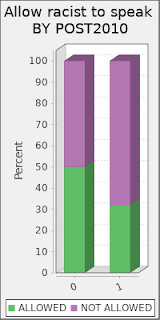
Unfortunately, support for allowing someone with controversial racial views to speak in public has fallen among Muslims in this decade from 50.0% to 31.8%. Not good.
In my view, a core value of the American system is free speech. If you don't believe in allowing people to state controversial opinions in public, you're not much of an American.
Here are the percentages in favor of free speech by religion. Many American Muslims are blacks--I excluded them since we would expect many of them to oppose free speech for people with messages that make blacks look bad:

Of all religions, Muslims are the least supportive of free speech.
Have attitudes among Muslims improved or worsened over time? I divided the data into two periods: 1) pre-2010 and 2) this decade:

Unfortunately, support for allowing someone with controversial racial views to speak in public has fallen among Muslims in this decade from 50.0% to 31.8%. Not good.
Another study showing that you can tell someone's IQ by looking at his brain (especially if he is a she)
I recently reported on researchers who were able to explain 95% of the variation in general intelligence based on the morphology of the brain. Just amazing. Now I run across another new study--they keep pouring out--conducted by Chinese researchers that found very strong correlations between the functional connectivity of various regions of the brain and intelligence.
They mapped out thousands of nodes and the connections between nodes and found that eight connections were important for males, and 13 different connections that were crucial for predicting female IQ. Smart women have differently wired brains than smart men. Smart women benefitted from efficient overall brain connectivity, while smart men tended to have better wiring in specific regions of the brains.
The connections identified for women predicted female IQ more powerfully than "male" connections predicted male IQ. They explained 72% of the variation in intelligence for women and 46% for men. You really can predict someone's IQ by looking at the brain, but you've got to look at different networks depending on whether it's a man or woman. SEX DIFFERENCES MATTER!
They mapped out thousands of nodes and the connections between nodes and found that eight connections were important for males, and 13 different connections that were crucial for predicting female IQ. Smart women have differently wired brains than smart men. Smart women benefitted from efficient overall brain connectivity, while smart men tended to have better wiring in specific regions of the brains.
The connections identified for women predicted female IQ more powerfully than "male" connections predicted male IQ. They explained 72% of the variation in intelligence for women and 46% for men. You really can predict someone's IQ by looking at the brain, but you've got to look at different networks depending on whether it's a man or woman. SEX DIFFERENCES MATTER!
Sunday, September 08, 2019
If you want a large family, this type of woman is your best bet
Using the General Social Survey (GSS) data, I looked to see which factors best predict that a woman will decide to have a large family.
I thought women from the South would have more kids, but they didn't differ from Northerners, and while conservative women have larger families, the impact is not large. IQ also predicts fewer children, but the effect is small.
I found that: 1) ideal family size, 2) church attendance, and 3) educational level, in particular, are the strongest predictors of the total number of offspring.
I'll present two women to illustrate. The first woman says that seven children is the ideal family size. She attends church more than once a week, and she went no further than high school. The data predict that she will have 3.7 children.
The second woman says zero kids is the ideal size for a family. She never goes to church, and she has 20 years of education. The model based on the data predicts she will have .56 kids. The first woman is predicted to have 6.6 more children than the second woman.
Again, the most powerful predictor by far is education. It's even more predictive than what a woman says about ideal family size.
UPDATE: Looking at older data, I found a predictor even more powerful than education: age at marriage. Women who are younger when they get married have significantly more kids.
I thought women from the South would have more kids, but they didn't differ from Northerners, and while conservative women have larger families, the impact is not large. IQ also predicts fewer children, but the effect is small.
I found that: 1) ideal family size, 2) church attendance, and 3) educational level, in particular, are the strongest predictors of the total number of offspring.
I'll present two women to illustrate. The first woman says that seven children is the ideal family size. She attends church more than once a week, and she went no further than high school. The data predict that she will have 3.7 children.
The second woman says zero kids is the ideal size for a family. She never goes to church, and she has 20 years of education. The model based on the data predicts she will have .56 kids. The first woman is predicted to have 6.6 more children than the second woman.
Again, the most powerful predictor by far is education. It's even more predictive than what a woman says about ideal family size.
UPDATE: Looking at older data, I found a predictor even more powerful than education: age at marriage. Women who are younger when they get married have significantly more kids.
Subscribe to:
Posts (Atom)
Are gun owners mentally ill?
Some anti-gun people think owning a gun is a sign of some kind of mental abnormality. According to General Social Survey data, gun owners ...

-
Via a reader at iSteve, it looks like this might be the vocabulary test used by the General Social Survey. (Someone please tell me if I'...
-
 In the comments in the last post , some readers contended that Jews are not ethnocentric. Using the same question I used in the comments se...
 -
Here's the second set I promised. A reader suggested that the first set tends to be older, and it is among younger blacks where you see ...
