It's the 10th anniversary of 10,000 Year Explosion, a fantastic book by Gregory Cochran and the late Henry Harpending. You MUST read it if you haven't. I command you.
The book is chock full of provocative hypotheses about humans. Let's test just one of them with General Social Survey (GSS) data. The authors explain that hunter-gatherers routinely share resources, in part because it is difficult for mobile people to hold on to things. It's also advantageous to cement positive ties and to make others feel obligated to you by being generous with them.
By contrast, farming selects for people who are good at holding on to possessions: seed grain, breeding stock, land, etc. A farmer who gives away everything will starve.
So Cochran and Harpending predict that ethnic groups lacking deep histories of agriculture will tend to be quicker to share with others. In the US context, this would be American Indians and blacks.
The GSS asked respondents: "People help other people in ways besides giving money, time, or other things to organized groups. Sometimes people help needy people directly. During the past 12 months, did you or members of your family or household give money, food, or clothing to any of the following types of people: The homeless or street-people."
Here are the percentages who answered yes:
Percent giving to the homeless in the past year
American Indian 55.4
Blacks 45.7
Irish 44.0
East Asian 41.7
Total sample 40.2
Mexican 39.4
Italian 37.7
French 37.0
Russian 36.8
German 34.2
English/Welsh 33.1
Scottish 30.4
Asian Indian 28.6
Norwegian 20.0
Even though American Indians and blacks are poor groups, they are more likely to give to the homeless. Groups with long agricultural histories are less likely to give, even if they are wealthy like Asian Indians.
And if you argue that giving to the homeless is largely an urban thing, American Indians tend to live in rural areas but are at the top of the list, while urban Asian Indians are at the bottom.
Thursday, September 12, 2019
Wednesday, September 11, 2019
Are Muslims in America assimilating or not?
Since today is the anniversary of 9/11, let's take a moment to see how well Muslims are assimilating in American society. The General Social Survey (GSS) asked respondents, "Consider a person who believes that Blacks are genetically inferior. If such a person wanted to make a speech in your community claiming that Blacks are inferior, should he be allowed to speak, or not?"
In my view, a core value of the American system is free speech. If you don't believe in allowing people to state controversial opinions in public, you're not much of an American.
Here are the percentages in favor of free speech by religion. Many American Muslims are blacks--I excluded them since we would expect many of them to oppose free speech for people with messages that make blacks look bad:

Of all religions, Muslims are the least supportive of free speech.
Have attitudes among Muslims improved or worsened over time? I divided the data into two periods: 1) pre-2010 and 2) this decade:
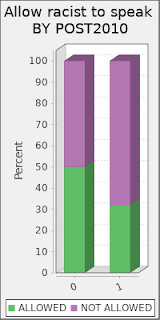
Unfortunately, support for allowing someone with controversial racial views to speak in public has fallen among Muslims in this decade from 50.0% to 31.8%. Not good.
In my view, a core value of the American system is free speech. If you don't believe in allowing people to state controversial opinions in public, you're not much of an American.
Here are the percentages in favor of free speech by religion. Many American Muslims are blacks--I excluded them since we would expect many of them to oppose free speech for people with messages that make blacks look bad:

Of all religions, Muslims are the least supportive of free speech.
Have attitudes among Muslims improved or worsened over time? I divided the data into two periods: 1) pre-2010 and 2) this decade:

Unfortunately, support for allowing someone with controversial racial views to speak in public has fallen among Muslims in this decade from 50.0% to 31.8%. Not good.
Another study showing that you can tell someone's IQ by looking at his brain (especially if he is a she)
I recently reported on researchers who were able to explain 95% of the variation in general intelligence based on the morphology of the brain. Just amazing. Now I run across another new study--they keep pouring out--conducted by Chinese researchers that found very strong correlations between the functional connectivity of various regions of the brain and intelligence.
They mapped out thousands of nodes and the connections between nodes and found that eight connections were important for males, and 13 different connections that were crucial for predicting female IQ. Smart women have differently wired brains than smart men. Smart women benefitted from efficient overall brain connectivity, while smart men tended to have better wiring in specific regions of the brains.
The connections identified for women predicted female IQ more powerfully than "male" connections predicted male IQ. They explained 72% of the variation in intelligence for women and 46% for men. You really can predict someone's IQ by looking at the brain, but you've got to look at different networks depending on whether it's a man or woman. SEX DIFFERENCES MATTER!
They mapped out thousands of nodes and the connections between nodes and found that eight connections were important for males, and 13 different connections that were crucial for predicting female IQ. Smart women have differently wired brains than smart men. Smart women benefitted from efficient overall brain connectivity, while smart men tended to have better wiring in specific regions of the brains.
The connections identified for women predicted female IQ more powerfully than "male" connections predicted male IQ. They explained 72% of the variation in intelligence for women and 46% for men. You really can predict someone's IQ by looking at the brain, but you've got to look at different networks depending on whether it's a man or woman. SEX DIFFERENCES MATTER!
Sunday, September 08, 2019
If you want a large family, this type of woman is your best bet
Using the General Social Survey (GSS) data, I looked to see which factors best predict that a woman will decide to have a large family.
I thought women from the South would have more kids, but they didn't differ from Northerners, and while conservative women have larger families, the impact is not large. IQ also predicts fewer children, but the effect is small.
I found that: 1) ideal family size, 2) church attendance, and 3) educational level, in particular, are the strongest predictors of the total number of offspring.
I'll present two women to illustrate. The first woman says that seven children is the ideal family size. She attends church more than once a week, and she went no further than high school. The data predict that she will have 3.7 children.
The second woman says zero kids is the ideal size for a family. She never goes to church, and she has 20 years of education. The model based on the data predicts she will have .56 kids. The first woman is predicted to have 6.6 more children than the second woman.
Again, the most powerful predictor by far is education. It's even more predictive than what a woman says about ideal family size.
UPDATE: Looking at older data, I found a predictor even more powerful than education: age at marriage. Women who are younger when they get married have significantly more kids.
I thought women from the South would have more kids, but they didn't differ from Northerners, and while conservative women have larger families, the impact is not large. IQ also predicts fewer children, but the effect is small.
I found that: 1) ideal family size, 2) church attendance, and 3) educational level, in particular, are the strongest predictors of the total number of offspring.
I'll present two women to illustrate. The first woman says that seven children is the ideal family size. She attends church more than once a week, and she went no further than high school. The data predict that she will have 3.7 children.
The second woman says zero kids is the ideal size for a family. She never goes to church, and she has 20 years of education. The model based on the data predicts she will have .56 kids. The first woman is predicted to have 6.6 more children than the second woman.
Again, the most powerful predictor by far is education. It's even more predictive than what a woman says about ideal family size.
UPDATE: Looking at older data, I found a predictor even more powerful than education: age at marriage. Women who are younger when they get married have significantly more kids.
Saturday, September 07, 2019
Blockbuster study on the black-white gap in intelligence
This new study on ancestry and cognitive ability by Jordan Lasker and team blew my mind. If NN Taleb is right that IQ research is crap, then all other social science is complete shit. Ever since I read Arthur Jensen's g Factor in 1998, I've been damned impressed by the quality of general intelligence research. I believe George Bernard Shaw said that Das Kapital made a man out of him. g Factor made a man out of me.
Jensen and Phil Rushton, vilified forever by Leftists, predicted that between 50 and 80% of the black-white gap in general intelligence was due to genetic differences. The Lefties predicted that genes explain none of the gap.
Lasker et al's study examined thousands of SNPs (DNA points) for thousands of blacks, whites, and biracials, and found that percent European ancestry explains 50-70% of the racial gap. Jensen and Rushton win, the feel-good researchers lose.
The Lefties also argued that skin color is a measure of how much a person is discriminated against, and discrimination explains the racial gap in IQ. Jensen and Rushton predicted that discrimination would not be an important cause of the difference.
Lasker and team found that skin color (discrimination) explained very little of the racial gap. Again, Jensen/Rushton emerge as the real scientists--the people whose predictions come true.
This study has moved my view on the racial gap from "probably mostly genetic" to "almost certainly mostly genetic."
Jensen and Phil Rushton, vilified forever by Leftists, predicted that between 50 and 80% of the black-white gap in general intelligence was due to genetic differences. The Lefties predicted that genes explain none of the gap.
Lasker et al's study examined thousands of SNPs (DNA points) for thousands of blacks, whites, and biracials, and found that percent European ancestry explains 50-70% of the racial gap. Jensen and Rushton win, the feel-good researchers lose.
The Lefties also argued that skin color is a measure of how much a person is discriminated against, and discrimination explains the racial gap in IQ. Jensen and Rushton predicted that discrimination would not be an important cause of the difference.
Lasker and team found that skin color (discrimination) explained very little of the racial gap. Again, Jensen/Rushton emerge as the real scientists--the people whose predictions come true.
This study has moved my view on the racial gap from "probably mostly genetic" to "almost certainly mostly genetic."
Wednesday, August 28, 2019
Does prenatal testosterone determine sexual orientation? A look at racial differences
The conventional wisdom is that sexual orientation, at least for men, is genetic, but the heritability estimates are actually rather weak.
Some researchers have theorized that homosexuality is caused by prenatal exposure to testosterone (T). Baby boys develop into gay men if they are exposed to insufficient levels of T during a critical period of development, and baby girls develop into lesbians if they were exposed to high prenatal levels. The level of T isn't the only factor: individuals also differ in terms of how sensitive they are to T.
If such a theory were true, we should see racial differences in sexual orientation because blacks tend to be more sensitive to T than whites. Their androgen receptors genes located on the X chromosome tend to be more responsive to androgens. We should see a lower prevalence of black gay men and a higher percent of black lesbians.
The General Social Survey asks about sexual orientation. Here are the responses by race (sample size = 26,227):
Percent homosexual
Blacks
Men 3.8
Women 2.2
Whites
Men 3.0
Women 2.3
These numbers fail to support the theory for both men and women. There should be more white gay men, but there are fewer. There should be more black lesbians, but their prevalence is very similar to that of white women.
How do black and white males differ in a way that would lead to more black gay men? I'm not sure. Greg Cochran theorizes that homosexuality is caused by some unidentified prenatal infection, and it might be the case that blacks live in conditions conducive to more infections.
Some researchers have theorized that homosexuality is caused by prenatal exposure to testosterone (T). Baby boys develop into gay men if they are exposed to insufficient levels of T during a critical period of development, and baby girls develop into lesbians if they were exposed to high prenatal levels. The level of T isn't the only factor: individuals also differ in terms of how sensitive they are to T.
If such a theory were true, we should see racial differences in sexual orientation because blacks tend to be more sensitive to T than whites. Their androgen receptors genes located on the X chromosome tend to be more responsive to androgens. We should see a lower prevalence of black gay men and a higher percent of black lesbians.
The General Social Survey asks about sexual orientation. Here are the responses by race (sample size = 26,227):
Percent homosexual
Blacks
Men 3.8
Women 2.2
Whites
Men 3.0
Women 2.3
These numbers fail to support the theory for both men and women. There should be more white gay men, but there are fewer. There should be more black lesbians, but their prevalence is very similar to that of white women.
How do black and white males differ in a way that would lead to more black gay men? I'm not sure. Greg Cochran theorizes that homosexuality is caused by some unidentified prenatal infection, and it might be the case that blacks live in conditions conducive to more infections.
Monday, August 26, 2019
Study: You can tell if someone is smart and male or female by looking at their brain
A recent, amazing study looked at how strongly the morphology of the brain (as measured by structural brain MRI scans) predicts IQ and the sex of the research subject. The graph below shows the results from two different data sets. "Morphometricity" on the y-axis is defined as the proportion of the variation of the trait that is explained by variation in brain morphology.

The morphology of the brain explains NINETY-FIVE percent of the variation in IQ. In other words, intelligence is very strongly predicted by the "architecture" of the brain. And gender? Morphology explains NINETY-THREE percent of the variation in sex, or whether the subject is male or female.
In a table not show here, brain morphology only explains 55% of ADHD, 50% of schizophrenia, 38% of autism, and 20% of Parkinson's.
Now, if gender and IQ are merely social constructions and are not biologically meaning, why are they so closely related to brain morphology, even more closely related than several brain diseases? People who push the biology-doesn't-really-matter-for-IQ-and-gender view are idiots and liars.

The morphology of the brain explains NINETY-FIVE percent of the variation in IQ. In other words, intelligence is very strongly predicted by the "architecture" of the brain. And gender? Morphology explains NINETY-THREE percent of the variation in sex, or whether the subject is male or female.
In a table not show here, brain morphology only explains 55% of ADHD, 50% of schizophrenia, 38% of autism, and 20% of Parkinson's.
Now, if gender and IQ are merely social constructions and are not biologically meaning, why are they so closely related to brain morphology, even more closely related than several brain diseases? People who push the biology-doesn't-really-matter-for-IQ-and-gender view are idiots and liars.
Saturday, August 24, 2019
You've got two kinds of people (or perhaps four)
Richard Lynn's new book Race Differences in Psychopathic Personality makes a convincing case that blacks and American Indians score high on exploitativeness (my term) while Asians tend to be the opposite--let's call this "fairness." Whites are closer to Asians, while Hispanics are what you would expect as a hybrid of white and Native American.
People who accept human biodiversity (HBD) tend to focus on general intelligence, and for good reason: it is very important for individuals, societies, and for all of humanity. But let me also stress the importance of this exploitativeness-fairness continuum. Your life will be better if you deal with people who are smart and fair rather than cunning and exploitative.
So this leads to a typology of four kinds of people: 1) smart-fair, 2) smart-exploitative, 3) dumb-fair, and 4) dumb-exploitative. I don't know about you, but I've known plenty of examples of each, but the situation tends to actually get simpler in the aggregate because at this level smart and fair tend to go together. Asians as a group not only score low on psychopathy, they are also highly intelligent. Blacks tend to be exploitative and unintelligent. So at the macrolevel, there is a tendency toward two types: more contributive and less contributive people.
You might counter that history shows lots of Asian exploitativeness. The Rape of Nanking, etc., etc. Humans treat each other horribly all the time, but my contention is that the average traits of people have an important impact on the quality of a society. A key reason why Japan is a better country than Nigeria is that it has a higher prevalence of intelligent, fair people.
People who accept human biodiversity (HBD) tend to focus on general intelligence, and for good reason: it is very important for individuals, societies, and for all of humanity. But let me also stress the importance of this exploitativeness-fairness continuum. Your life will be better if you deal with people who are smart and fair rather than cunning and exploitative.
So this leads to a typology of four kinds of people: 1) smart-fair, 2) smart-exploitative, 3) dumb-fair, and 4) dumb-exploitative. I don't know about you, but I've known plenty of examples of each, but the situation tends to actually get simpler in the aggregate because at this level smart and fair tend to go together. Asians as a group not only score low on psychopathy, they are also highly intelligent. Blacks tend to be exploitative and unintelligent. So at the macrolevel, there is a tendency toward two types: more contributive and less contributive people.
You might counter that history shows lots of Asian exploitativeness. The Rape of Nanking, etc., etc. Humans treat each other horribly all the time, but my contention is that the average traits of people have an important impact on the quality of a society. A key reason why Japan is a better country than Nigeria is that it has a higher prevalence of intelligent, fair people.
Thursday, August 22, 2019
Occam's Razor demands the simplest explanation: races are internally different
Richard Lynn's new book Race Differences in Psychopathic Personality describes hundreds of studies conducted around the world. One American study that strikes me is a simple one of racial differences in doing one's homework that is described on page 61.
The mean number of hours studied per week by high school seniors looks like this: Asians, 3.9; whites, 3.4; Hispanics and blacks, 2.0. Asian teens study roughly twice as much as other minorities.
Academic apologists work full-time concocting reasons for the racial gaps we see, but how do we blame homework differences on malevolent, discriminatory whites? Homework is done at home with no whites looking over your shoulder. The schools provide even poor minority kids with books and materials for assignments. Parents and kids simply decide how much time gets devoted to studying.
You might respond that minority kids are given less homework because of the "bigotry of low expectations." But why do Asians do more than whites? If you answer that schools are just following stereotypes, so schools with lots of Asian students assign more homework, it simply starts to seem like schools might respond to what students are like, or hardworking families select schools with higher expectations.
It just becomes absurd to pin these racial gaps on anything at all bad that whites do. Again and again, we see that whites are mediocre. What sort of white supremacist country sorts whites into the undistinguished middle? I want a better brand of supremacy!
After reading Lynn's descriptions on more than 700 studies from dozens of countries, Occam's Razor demands the simplest explanation: the races are internally different.

The mean number of hours studied per week by high school seniors looks like this: Asians, 3.9; whites, 3.4; Hispanics and blacks, 2.0. Asian teens study roughly twice as much as other minorities.
Academic apologists work full-time concocting reasons for the racial gaps we see, but how do we blame homework differences on malevolent, discriminatory whites? Homework is done at home with no whites looking over your shoulder. The schools provide even poor minority kids with books and materials for assignments. Parents and kids simply decide how much time gets devoted to studying.
You might respond that minority kids are given less homework because of the "bigotry of low expectations." But why do Asians do more than whites? If you answer that schools are just following stereotypes, so schools with lots of Asian students assign more homework, it simply starts to seem like schools might respond to what students are like, or hardworking families select schools with higher expectations.
It just becomes absurd to pin these racial gaps on anything at all bad that whites do. Again and again, we see that whites are mediocre. What sort of white supremacist country sorts whites into the undistinguished middle? I want a better brand of supremacy!
After reading Lynn's descriptions on more than 700 studies from dozens of countries, Occam's Razor demands the simplest explanation: the races are internally different.
Saturday, August 17, 2019
Has more "play choking" in porn led to more strangulation homicides?
Mass shootings always get people talking about the causes of violence, but these are rare acts that in some ways are atypical. For one thing, most homicide involves a single victim, and the perp typically has a specific beef with the victim. Mass shooters often shoot "symbolic" victims: more or less random members of a class of people they have a grievance against.
Women are usually murdered by a man they have they have a current or former relationship with. With the rise in recent years of "play choking" in pornographic scenes, I thought I could test the psychologists' hypothesis that witnessing images of acted-out violence, even play violence, can put ideas into the heads of people, especially violent-prone individuals, that increase the risk of homicide.
The CDC has a great website that allows you to generate trends on specific causes of mortality. I was able to make a chart of the rates of homicide by choking among female victims since 1999.

Over this period, this type of homicide has fallen from 3.3 to 1.8 deaths per 1 million females, so the pornography hypothesis is not supported. While the rate has flattened over the past several years--the years where play choking has gotten more popular--there is no increase as the hypothesis would predict.
Women are usually murdered by a man they have they have a current or former relationship with. With the rise in recent years of "play choking" in pornographic scenes, I thought I could test the psychologists' hypothesis that witnessing images of acted-out violence, even play violence, can put ideas into the heads of people, especially violent-prone individuals, that increase the risk of homicide.
The CDC has a great website that allows you to generate trends on specific causes of mortality. I was able to make a chart of the rates of homicide by choking among female victims since 1999.

Over this period, this type of homicide has fallen from 3.3 to 1.8 deaths per 1 million females, so the pornography hypothesis is not supported. While the rate has flattened over the past several years--the years where play choking has gotten more popular--there is no increase as the hypothesis would predict.
Thursday, August 15, 2019
One reason why sociology is evil
Following Jeffrey Epstein's death, we have learned where he found his justification for raping teenage girls. He explained to an interviewer that, "criminalizing sex with teenage girls was a cultural aberration, and that at times in history it was perfectly acceptable.” “He pointed out that homosexuality had long been considered a crime and was still punishable by death in some parts of the world.”
Various social science disciplines, especially cultural anthropology and sociology, enlighten every freshman with the brilliant insight that the world's 7.7 billion people don't agree on every point of right and wrong, and today's norms can vary from those of past societies. This truth is banal and harmless enough, but then these "scientists" pull a fast only and imply that since values have varied, there is NO objective morality. The values and rules we live by are just arbitrary and were simply invented willy-nilly by someone in the past. They are mere conventions, so when your mom tells you sex with underage girls is wrong, you can say that many cultures have not had a problem with it, and rules against it are merely prejudice and superstition. This technique makes it very easy to follow your desires, whatever they may be.
Of course, these social scientists are either fools or liars. The question of objective morality--whether there is right and wrong independent of what people think--is not answered by the fact that cultures have varied on what is moral. Objective morality might exist, and like a bullseye, has been missed by various degrees by various cultures. But since the one cardinal rule for social thinkers is that "all cultures are equal," then it becomes impossible for some groups to be better shots than others.
These are questions for philosophers, not dumbass sociologists. Social scientists pose as if they are value-neutral, or at least they used to, but they constantly smuggle in their "anything goes" value systems, although "systems" give their thinking too much credit. And they are too obtuse to see how their bad philosophy helps the Epsteins of the world commit their crimes.
Various social science disciplines, especially cultural anthropology and sociology, enlighten every freshman with the brilliant insight that the world's 7.7 billion people don't agree on every point of right and wrong, and today's norms can vary from those of past societies. This truth is banal and harmless enough, but then these "scientists" pull a fast only and imply that since values have varied, there is NO objective morality. The values and rules we live by are just arbitrary and were simply invented willy-nilly by someone in the past. They are mere conventions, so when your mom tells you sex with underage girls is wrong, you can say that many cultures have not had a problem with it, and rules against it are merely prejudice and superstition. This technique makes it very easy to follow your desires, whatever they may be.
Of course, these social scientists are either fools or liars. The question of objective morality--whether there is right and wrong independent of what people think--is not answered by the fact that cultures have varied on what is moral. Objective morality might exist, and like a bullseye, has been missed by various degrees by various cultures. But since the one cardinal rule for social thinkers is that "all cultures are equal," then it becomes impossible for some groups to be better shots than others.
These are questions for philosophers, not dumbass sociologists. Social scientists pose as if they are value-neutral, or at least they used to, but they constantly smuggle in their "anything goes" value systems, although "systems" give their thinking too much credit. And they are too obtuse to see how their bad philosophy helps the Epsteins of the world commit their crimes.
Tuesday, August 13, 2019
How does gay promiscuity compare with that of lesbians?
Looking at sexual orientation, gender, and variety of sex partners is a good way to show how men and women really are very different. (The need to document this shows the crazy times we live in.)
According to evolutionary theory, since men can pass on their genes with minimal commitment, they have evolved the tendency to desire non-committal sex with a variety of partners. Since having children is such a tremendous investment for women, they have been selected to be much choosier about sexual partners. It's not typically hard for a women to get sex, but it can be a challenge to find partners who have the willingness and ability to provide resources to the offspring, or at least who have high-quality genes to pass on to one's children.
If you're paying attention, you can see that a conflict arises: men who want many partners, and women who want few. So many men are not able to get what they want. But what about gay men? There is no sexual conflict for them: just a bunch of guys who want novelty.
The General Social Survey (GSS) asked adults about: 1) sexual orientation, and 2) the number of male and female sex partners since age 18 (sample size = 23,579). Let's look at the numbers for male partners first:

Gay men average 43 male partners--much more than any other group. Coming in at a distant second is male bisexuals with close to 15 men. Female bisexuals have a mean of roughly 12 male partners, and straight women report an average of 5.5. The average for lesbians is a little over two men.
Now for the number of female sex partners since 18:

The category with the most women partners is bisexual men with a mean of almost 20. Next is straight men with almost 16 1/2. Lesbians average close to eight female partners, and the mean for female bisexuals is around 5. The mean for gay men is 2.6 women.
If we add together partners of either gender, the ranking for the total number of sex partners since 18 looks like this: #1) gay men, #2) bisexual men, #3) bisexual women, #4) straight men, #5) lesbians and #6) straight women.
So, sexual minorities have the most partners, but gay men and lesbians stick out; gay men because their numbers are so much higher, and lesbians because their numbers are atypically low. Compared to lesbians, gays have around 4 1/2 times the number of partners.
This is consistent with evolutionary theory: men like sexual variety much more than women, and they show this most clearly when they are pursuing partners who also like variety; namely, other men. Lesbians are not like other sexual minorities in that they do not pursue variety much. Why? Because they are women dealing with female partners.
According to evolutionary theory, since men can pass on their genes with minimal commitment, they have evolved the tendency to desire non-committal sex with a variety of partners. Since having children is such a tremendous investment for women, they have been selected to be much choosier about sexual partners. It's not typically hard for a women to get sex, but it can be a challenge to find partners who have the willingness and ability to provide resources to the offspring, or at least who have high-quality genes to pass on to one's children.
If you're paying attention, you can see that a conflict arises: men who want many partners, and women who want few. So many men are not able to get what they want. But what about gay men? There is no sexual conflict for them: just a bunch of guys who want novelty.
The General Social Survey (GSS) asked adults about: 1) sexual orientation, and 2) the number of male and female sex partners since age 18 (sample size = 23,579). Let's look at the numbers for male partners first:

Gay men average 43 male partners--much more than any other group. Coming in at a distant second is male bisexuals with close to 15 men. Female bisexuals have a mean of roughly 12 male partners, and straight women report an average of 5.5. The average for lesbians is a little over two men.
Now for the number of female sex partners since 18:

The category with the most women partners is bisexual men with a mean of almost 20. Next is straight men with almost 16 1/2. Lesbians average close to eight female partners, and the mean for female bisexuals is around 5. The mean for gay men is 2.6 women.
If we add together partners of either gender, the ranking for the total number of sex partners since 18 looks like this: #1) gay men, #2) bisexual men, #3) bisexual women, #4) straight men, #5) lesbians and #6) straight women.
So, sexual minorities have the most partners, but gay men and lesbians stick out; gay men because their numbers are so much higher, and lesbians because their numbers are atypically low. Compared to lesbians, gays have around 4 1/2 times the number of partners.
This is consistent with evolutionary theory: men like sexual variety much more than women, and they show this most clearly when they are pursuing partners who also like variety; namely, other men. Lesbians are not like other sexual minorities in that they do not pursue variety much. Why? Because they are women dealing with female partners.
Monday, August 05, 2019
Who has sex more often--straights, gays, or bi-sexuals?
We straight people tend to be sexually repressed, right? Isn't that what we're told by the experts? That is hardly the case. The General Social Survey asked American adults how often they've had sex in the past year (sample size = 23,771). I've listed the modal category for each sex/orientation group, and by modal category I mean the most frequently given answer. The percent who gave the modal answer is given in parentheses:
Modal category is 2-3 times per week
Straight men (24.0%)
Straight women (25.0%)
Modal category is weekly
Bisexual women (20.6%)
Modal category is 2-3 times per month
Gay men (20.6%)
Bisexual men (28.4%)
Lesbians (25.8%)
The pattern is clear here: straight people have sex more often than sexual minorities. We even have more frequent sex than bisexuals who have double the potential partners! We don't need to look to them about a healthy sex life. They need to look to us.
Now, you might be skeptical, thinking how gay men seem to have sex like crazy. You know--who's going to put the brake on sex when it's two men involved?! Well, we're talking here about the frequency of sex, not the number of different partners. If your priority is variety (and perhaps STI's), gay men seem to have the advantage.
Modal category is 2-3 times per week
Straight men (24.0%)
Straight women (25.0%)
Modal category is weekly
Bisexual women (20.6%)
Modal category is 2-3 times per month
Gay men (20.6%)
Bisexual men (28.4%)
Lesbians (25.8%)
The pattern is clear here: straight people have sex more often than sexual minorities. We even have more frequent sex than bisexuals who have double the potential partners! We don't need to look to them about a healthy sex life. They need to look to us.
Now, you might be skeptical, thinking how gay men seem to have sex like crazy. You know--who's going to put the brake on sex when it's two men involved?! Well, we're talking here about the frequency of sex, not the number of different partners. If your priority is variety (and perhaps STI's), gay men seem to have the advantage.
Friday, August 02, 2019
Data: Almost one-quarter of black men are exploitative compared to ZERO percentage of Chinese men
A recent post focused on racial differences in psychopathy, and while people know the obvious connection between being a psychopath and committing crimes, few realize that the correlation between a promiscuous lifestyle and psychopathy is about as strong. In fact, a lifestyle of casual sex is one criterion for diagnosing psychopathic personality. Evolutionary psychologists have developed the concept of sociosexuality, which refers to an interest in non-committal sex. The correlation between sociosexuality and psychopathy is roughly 0.4, an impressive number. It's strong enough that factor analysis would probably reveal one supertrait that underlies psychopathy, criminality, and sociosexuality--a syndrome we could call exploitativeness.
So, are there racial and ethnic differences in sociosexuality or exploitativeness (as indicated by high sociosexuality)? The General Social Survey does have one item used in sociosexuality inventories--the number of sexual partners since age 18. Let's pick an arbitrary cutoff--25+ partners--to indicate exploitativeness. For now, I will focus on men and will limit analysis to ethnic groups with at least 50 respondents (sample size = 10,789):
Percent with 25+ sexual partners since age 18
Black 24.3
Scottish 19.8
Spanish 19.7
Jewish 19.1
American Indian 18.2
Greek 18.2
Italian 16.6
Puerto Rican 15.7
Other Spanish 14.9
Norwegian 14.6
Irish 14.4
Percent for total sample 14.1
Russian 13.9
French 13.5
English/Welsh 12.9
Austrian 11.5
Polish 11.4
German 11.2
French Canadian 10.2
Swedish 10.1
Dutch 9.9
Mexican 8.7
Danish 8.2
Czech 7.8
Asian Indian 4.1
Filipino 3.3
Chinese 0.0
You can see that by selecting a cutoff of 25 partners, this gives us 14.1% of US men being exploitative. More importantly for this post, we see tremendous diversity in this trait. Almost one-quarter of black men are exploitative compared to ZERO Chinese men. Looking at general patterns, Southern Europeans tend to have higher numbers, while Asians fall to the bottom. These patterns are consistent with numbers presented in Richard Lynn's Race Differences in Psychopathic Personality. He found high psychopathy among blacks and American Indians, moderate levels among whites, and low levels among Asians.
So, are there racial and ethnic differences in sociosexuality or exploitativeness (as indicated by high sociosexuality)? The General Social Survey does have one item used in sociosexuality inventories--the number of sexual partners since age 18. Let's pick an arbitrary cutoff--25+ partners--to indicate exploitativeness. For now, I will focus on men and will limit analysis to ethnic groups with at least 50 respondents (sample size = 10,789):
Percent with 25+ sexual partners since age 18
Black 24.3
Scottish 19.8
Spanish 19.7
Jewish 19.1
American Indian 18.2
Greek 18.2
Italian 16.6
Puerto Rican 15.7
Other Spanish 14.9
Norwegian 14.6
Irish 14.4
Percent for total sample 14.1
Russian 13.9
French 13.5
English/Welsh 12.9
Austrian 11.5
Polish 11.4
German 11.2
French Canadian 10.2
Swedish 10.1
Dutch 9.9
Mexican 8.7
Danish 8.2
Czech 7.8
Asian Indian 4.1
Filipino 3.3
Chinese 0.0
You can see that by selecting a cutoff of 25 partners, this gives us 14.1% of US men being exploitative. More importantly for this post, we see tremendous diversity in this trait. Almost one-quarter of black men are exploitative compared to ZERO Chinese men. Looking at general patterns, Southern Europeans tend to have higher numbers, while Asians fall to the bottom. These patterns are consistent with numbers presented in Richard Lynn's Race Differences in Psychopathic Personality. He found high psychopathy among blacks and American Indians, moderate levels among whites, and low levels among Asians.
Friday, July 26, 2019
All major brain regions are larger in men than women
The Left accuses the Right of being anti-science, but even the least educated conservative knows that men and women are different. While radical feminists keep propagandizing the gullible that gender differences are a myth perpetuated by the Patriarchy (email me the whens and wheres of our next secret meeting), real scientists are documenting the biological realities.
This meta-analysis of 126 studies shows very clearly that from birth to death males have bigger brains than females. Men, on average, had greater total volumes on all of the following measures: intracranial, cerebrum, gray matter, white matter, cerebellum, and cerebrospinal fluid. There was no major region that was larger in women. Depending on the study, male brains were between 8 and 13% larger.
The researchers also found significant volume differences in small regions. Men averaged larger gray matter volumes in 33 areas, and 17 regions in females had more gray matter. They also looked at gray matter density and reported that six regions in men were denser, while one area had greater density in women.
When regions are larger in males, they tend to be in the left hemisphere. When areas are larger in women, they tend to be in the right one, so there is evidence of lateralization differences between the sexes.
Differences seem to emerge in regions known to be involved in language and emotion. This makes sense since women tend to have a verbal advantage, and the sexes differ significantly in certain emotions like empathy.
Why do men have larger brains? It looks like the studies did not adjust for body size, but even if you argue that male brains are bigger simply because their bodies are bigger, why are many areas larger in women? Brains are very costly organs: they use a tremendous amount of energy, and big heads can kill mothers during birth. Bigger brains are there for a reason.
After reading Arthur Jensen, I assumed men and women had identical average IQs, and that men were simply more diverse with a greater number of dullards and geniuses. In recent years, evidence has emerged that, compared to females, male IQ peaks more slowly, and at a somewhat higher level (about four IQ points). Researchers like Jensen supposedly missed this by focusing on samples of adolescents rather than fully developed adults.
Perhaps the 10% bigger brain gives men a little more mental horsepower. It's a hazardous business to speculate why this would be. Whatever the reason, the difference is real, and the feminists are wrong.
I imagine a skeptic will argue that perhaps the differences are due to environmental factors: male babies are fed and treated better, boys are given more intellectual stimulation, etc. But why the differentiation where some regions are larger in men, while other areas are larger in women? And while the samples didn't allow a detailed study of age, it looks like the sex differences are in place among neonates. Differences emerge early in life before many social factors are able to kick in.
UPDATE: Many of the regions with a male advantage are in the limbic system which is associated with aggression and sexual interests. There are, of course, big sex differences in these traits.
UPDATE 2: As mentioned, areas that have greater volume in women tend to be in the right hemisphere which is associated with a proneness to negative emotions. While women are not more prone to anger than men, they do tend to be more anxious and depressed.
This meta-analysis of 126 studies shows very clearly that from birth to death males have bigger brains than females. Men, on average, had greater total volumes on all of the following measures: intracranial, cerebrum, gray matter, white matter, cerebellum, and cerebrospinal fluid. There was no major region that was larger in women. Depending on the study, male brains were between 8 and 13% larger.
The researchers also found significant volume differences in small regions. Men averaged larger gray matter volumes in 33 areas, and 17 regions in females had more gray matter. They also looked at gray matter density and reported that six regions in men were denser, while one area had greater density in women.
When regions are larger in males, they tend to be in the left hemisphere. When areas are larger in women, they tend to be in the right one, so there is evidence of lateralization differences between the sexes.
Differences seem to emerge in regions known to be involved in language and emotion. This makes sense since women tend to have a verbal advantage, and the sexes differ significantly in certain emotions like empathy.
Why do men have larger brains? It looks like the studies did not adjust for body size, but even if you argue that male brains are bigger simply because their bodies are bigger, why are many areas larger in women? Brains are very costly organs: they use a tremendous amount of energy, and big heads can kill mothers during birth. Bigger brains are there for a reason.
After reading Arthur Jensen, I assumed men and women had identical average IQs, and that men were simply more diverse with a greater number of dullards and geniuses. In recent years, evidence has emerged that, compared to females, male IQ peaks more slowly, and at a somewhat higher level (about four IQ points). Researchers like Jensen supposedly missed this by focusing on samples of adolescents rather than fully developed adults.
Perhaps the 10% bigger brain gives men a little more mental horsepower. It's a hazardous business to speculate why this would be. Whatever the reason, the difference is real, and the feminists are wrong.
I imagine a skeptic will argue that perhaps the differences are due to environmental factors: male babies are fed and treated better, boys are given more intellectual stimulation, etc. But why the differentiation where some regions are larger in men, while other areas are larger in women? And while the samples didn't allow a detailed study of age, it looks like the sex differences are in place among neonates. Differences emerge early in life before many social factors are able to kick in.
UPDATE: Many of the regions with a male advantage are in the limbic system which is associated with aggression and sexual interests. There are, of course, big sex differences in these traits.
UPDATE 2: As mentioned, areas that have greater volume in women tend to be in the right hemisphere which is associated with a proneness to negative emotions. While women are not more prone to anger than men, they do tend to be more anxious and depressed.
Sunday, July 21, 2019
A note on Lynn's "Race Differences in Psychopathic Personality"
Lance Welton at Unz.com does a nice job of summarizing Richard Lynn's brand new book Race Differences in Psychopathic Personality
I won't repeat Lance's points, but I see in the comments that some people are claiming that the racial differences are explained in terms of the environment. This, of course, is the standard explanation--the only one you will get in sociology class, if the instructor is honest enough to acknowledge that the group differences indeed exist.
There are two obvious reasons to think the racial gaps (psychopathy running from high to low in this order: black, Native American, Hispanic, white, Asian) are at least partially due to genetic differences: 1) the differences are basically universal–found historically (Lynn cites over 700 studies conducted from the 19th century to now) and all around the world, and 2) psychopathy is highly heritable, similar to general intelligence. Therapists find it practically impossible to treat.
As Arthur Jensen explained, it is reasonable to conclude that if genes explain 70% of the variation in a trait, they likely explain 70% of group differences. The only reason why the commonsense belief that “What You See is What You Get” is not popular today but “People Are Not Themselves But Their Surroundings” is assumed to be true is that we have been propagandized by armies of full-time storytellers for more than a century.
I do take issue with conceptualizing psychopathy as a disorder, as if human nature is naturally good, and antisociality suggests a brain that is not working properly. I’m not criticizing Lynn but psychiatry. Exploitativeness is a regrettable but perfectly healthy and natural supertrait. Psychiatrists want to turn all problematic behaviors into forms of mental illness, which is just silly. Evolution has designed us to thrive and to be strong, not to be burdened on every side by illness and weakness. Mainstream behavioral science portrays us--the descendants of nature's winners--as naturally frail. Complete BS.
Wednesday, July 17, 2019
Which ethnic groups think astrology is scientific?
It is important for America that we have people who understand and value science. The General Social Survey asked people residing in the US, "Would you say that astrology is very scientific, sort of scientific, or not at all scientific?" Anyone who understands science would not say astrology is scientific, even if they otherwise like it.
Let's look at the percentage who say astrology is very or sort of scientific listed by ethnic group (sample size = 6,873):
Percent who say astrology is scientific
Black 53.1
Mexican 50.6
Asian Indian 47.4
Puerto Rican 46.4
American Indian 45.1
Filipino 42.7
Spanish 41.2
Norwegian 38.5
All Americans 36.3
Chinese 35.5
Italian 35.1
Portuguese 34.3
Arab 32.1
Irish 31.1
French Canadian 30.8
Polish 29.9
French 29.5
Dutch 29.2
German 28.9
Japanese 28.5
Czech 27.7
Swiss 27.5
Russian 27.0
Greek 25.0
Scottish 24.3
Jewish 23.8
English 23.5
Danish 21.1
Swedish 15.1
Blacks, Hispanics, and American Indians top the list, but some high IQ ethnic groups are toward the top as well; namely, Asian Indians, Norwegians, and Chinese. Setting aside the Norwegians, there is a tendency for northwestern Europeans to fall to the bottom of the list. These groups are more skeptical and seem to understand better what it means to be scientific.
Let's look at the percentage who say astrology is very or sort of scientific listed by ethnic group (sample size = 6,873):
Percent who say astrology is scientific
Black 53.1
Mexican 50.6
Asian Indian 47.4
Puerto Rican 46.4
American Indian 45.1
Filipino 42.7
Spanish 41.2
Norwegian 38.5
All Americans 36.3
Chinese 35.5
Italian 35.1
Portuguese 34.3
Arab 32.1
Irish 31.1
French Canadian 30.8
Polish 29.9
French 29.5
Dutch 29.2
German 28.9
Japanese 28.5
Czech 27.7
Swiss 27.5
Russian 27.0
Greek 25.0
Scottish 24.3
Jewish 23.8
English 23.5
Danish 21.1
Swedish 15.1
Blacks, Hispanics, and American Indians top the list, but some high IQ ethnic groups are toward the top as well; namely, Asian Indians, Norwegians, and Chinese. Setting aside the Norwegians, there is a tendency for northwestern Europeans to fall to the bottom of the list. These groups are more skeptical and seem to understand better what it means to be scientific.
Sunday, July 14, 2019
Why would an animal programmed to survive and reproduce care so much about right and wrong?
In a recent post, I critiqued Richard Wrangham's theory of why humans are so much less violent than our cousins, the chimpanzees. In The Goodness Paradox, he also attempts to explain why we have a strong moral sense. It's strange for an animal designed to outcompete others through survival and greater reproductive success to care so much about abstract concepts of right and wrong.
He hypothesizes that human society changed fundamentally when men developed the language to coordinate control over other members of the group. While apes sometimes gang up and beat or kill a single, obnoxious ape, they don't plan it out ahead of time. Men gained a tremendous tool when they began to conspire as a group of five or six against one. They could discuss the idea, plan a surprise attack, and kill the offender with little danger to themselves. Sometimes the murder wasn't necessary: A rumor could be floated and the troublemaker might be convinced to change his ways.
Wrangham claims that men expanded their control to all members of the community so that everybody was were in fear of their ability to conduct a surprise attack against them. Over evolutionary time, humans were selected for their ability to please the men who had this power over them. Extremely selfish, exploitative people were weeded out. A person who treated everyone well was unlikely to displease elders, so prosociality became a more and more common trait. And while I didn't find Wrangham clear on this point, I think moral values gradually developed as a reflection of the prosocial personalities that were becoming common.
According to Wrangham, selection has been more successful at producing people oriented toward having a good reputation and appearing moral rather than creating humans of deep, genuine integrity and principle. After all, we are still programmed to care about our own reproductive interests.
I would return to my earlier criticism: In 2019, some groups seem to have much higher rates of prosociality than others. For example, a quick look at the Corruption Perceptions Index reveals that Denmark has very little public corruption compared to Somalia. How does Wrangham help us explain the enormous gulf between the two countries? He doesn't. He presents the image of all human groups across the globe being identical in terms of genes that contribute to cooperativeness. I suppose he would say that evolutionary biology tells the story up until the day before yesterday, but now it's irrelevant: It's all sociology now. Not credible.
Saturday, July 13, 2019
Who is more likely to be unfaithful: high- or low-income men?
The liberal instinctively idealizes and sympathizes with the man at the bottom of society (although liberals are becoming so crazy these days, it's getting hard to characterize them coherently.) By contrast, a certain brand of conservative might be tempted to idealize the successful man: Effort or perhaps good genes get a guy to the top.
Reality seems a little more complicated than that. Brains and discipline help a person rise, but so can Machiavellianism. I suspect that successful people tend to be a mixed bag.
Let's test the idea that there is moral virtue in successful people by looking at marital infidelity. I divided personal income into 5 levels and created graphs for white and black men (sample sizes = 7,959 and 894):
Black Men

White Men

Among black males, you see a spike in cheating among the highest income group. It's a smaller increase among high-earning white males.
So successful men are a little more likely to be unfaithful. You might attribute this to the greater attractiveness that comes with money or to greater social opportunities, but whatever the case, there is no indication here that successful men are more moral than others. It's important that we stick to reality and not ideology.
Reality seems a little more complicated than that. Brains and discipline help a person rise, but so can Machiavellianism. I suspect that successful people tend to be a mixed bag.
Let's test the idea that there is moral virtue in successful people by looking at marital infidelity. I divided personal income into 5 levels and created graphs for white and black men (sample sizes = 7,959 and 894):
Black Men

White Men

Among black males, you see a spike in cheating among the highest income group. It's a smaller increase among high-earning white males.
So successful men are a little more likely to be unfaithful. You might attribute this to the greater attractiveness that comes with money or to greater social opportunities, but whatever the case, there is no indication here that successful men are more moral than others. It's important that we stick to reality and not ideology.
Wednesday, July 10, 2019
Richard Wrangham works hard to explain the violence gap we don't care about
Urban Americans worry quite a bit about violence in their cities. Many of these places will rack up hundreds of homicides per year. Urban black men face a pretty decent chance of being murdered. So it was weird to read Richard Wrangham's new book The Goodness Paradox with its central claim that humans are very peaceful.
How could he have this view? Well, he has studied chimps for decades. Contrary to stories told by liberal primatologists in the 1960s, it turns out that chimps are mean bastards. If you stuffed 200 of them into Boeing 737, by the end of the flight many would be murdered. The human homicide rate is a tiny fraction of that seen among chimpanzees.
Wrangham then sets out to develop a theory to explain why we are so slow to lose our cool and attack others. He claims that when our ancestors developed the ability for fairly sophisticated language about 300-500k years ago, men in a group began to handle their antisocial members by plotting to murder them. Chimps will sometimes gang up on a cantankerous alpha and take him out, but it is spontaneous. No planning is involved.
Men gained great power over individuals by using premeditated, coalitionary aggression against not only bullies but eventually against all non-conformists. Over evolutionary time, this selected for humans who were motivated to get along with others and who were particularly interested in pleasing tribal elders--the men who had the power to kill them if they become sufficiently annoyed.
In developing his theory, Wrangham did exactly what I expected from a PC biologist: He avoids discussions of why human groups currently vary so much in their levels of homicide. Some educated person reading his book wants to know why his neighborhood is so much safer than the black neighborhood on the other side of town. The homicide rate in Colombia, for example, is scores of times higher than in Japan. Why? Wrangham is silent on this type of issue. He makes it sound like humanity has experienced the exact same selection pressures for hundreds of thousands of years, and that we all arrive at 2019 exactly the same in terms of genetic propensity for violence. He admits that the speed of selection probably increased in more recent millennia, but is silent about what that means.
Wrangham also fails to discuss the scholarship of Greg Cochran, Henry Harpending, and Peter Frost which suggests that pacification of some human groups has happened over the past few thousand years. I guess I would be silent on such topics, too, if I valued my lofty perch at the Department of Human Evolutionary Biology at Harvard University.
Subscribe to:
Posts (Atom)
Are gun owners mentally ill?
Some anti-gun people think owning a gun is a sign of some kind of mental abnormality. According to General Social Survey data, gun owners ...

-
 In the comments in the last post , some readers contended that Jews are not ethnocentric. Using the same question I used in the comments se...
 -
Via a reader at iSteve, it looks like this might be the vocabulary test used by the General Social Survey. (Someone please tell me if I'...
-
I've been distributing a questionnaire to students which, among other things, asks them their religion. Quite a few have answered "...